Demolition digs up memories
Margaret Peacock, 12 June 2023
I’m writing this on 12 June 2023. As I was walking along The Strand today, I looked down a
dark driveway for a peek of a building that my grandparents purchased 99 years ago!
I’d walked along the same route a couple of weeks before and all seemed as it had for years,
but today the sound of workmen attracted my attention. It was then that I noticed that the
building had disappeared. They were just finishing the clean-up of the demolition site.
Progress no doubt, and no great loss. We can lose a building that has sat there quietly in
recent decades, but not so quietly in its heyday; but we don’t need to lose its history.
This unassuming building at number 115-117 The Strand, between Sixth and Seventh
Avenues, was once the hub of Onetangi. It was built as a general store and dance floor a
little over 100 years ago. Its section stretched into the sandhills (and later onto the road
once The Strand was built in the early 1930s as a Depression Relief project). The shop had
been built near the base of the hill because the sand dunes, which were covered in lupins
and other dune plants, extended most of the way back to the hill. There was as yet no
Strand.
My grandparents, Bert and Estelle Le Roy, had come to Onetangi in December 1923 for the
Christmas holidays with their three pre-schoolers, to camp in tents at the bach owned by
Estelle’s mother in Victoria Road South.
During that summer, the building’s owners offered to sell it to them. Estelle and Bert
thought that they could make it their family home, so the deal was done. They hadn’t
realised that the stock was being left in the store, so as money was never easy to come by,
Estelle became the shop-keeper.
The only road to Onetangi at that time was Seaview Road, and a major portion of it ran
through the Kennedy’s farm, with up to 11 gates needing to be opened and closed. There
were no cars on the island, so Bert took his horse and cart to pick up stock for the shop from
the Ostend wharf. Seventh Avenue stopped where it met the sand at the bottom of the set
of stairs leading to Seaview Road. From there, a track led directly east at the base of the hill
to the store. It was along this track that horse, cart and rider brought essential supplies for
what was, at that time, a small remote settlement.
Bert and Estelle could see opportunities for increasing income from their new asset.
Estelle, who was a trained tailor, started a measuring service. Travel to Auckland was very
slow and ferry services were infrequent, so Estelle would send measurements to the city
suit-makers so that customers didn’t need to make that trip before work could begin on the
garment.
They also made an application for the first licence to show movies on Waiheke. As it was
successful, Bert built an addition to the shop to make space for a small cinema and a billiard
room. The shop was becoming an entertainment hub too. Once the Saturday night movie
finished, the music started and patrons were up on the dance floor. In the ‘Roaring Twenties’
this entertainment attracted people from near and far, the locals mainly coming on
horseback.
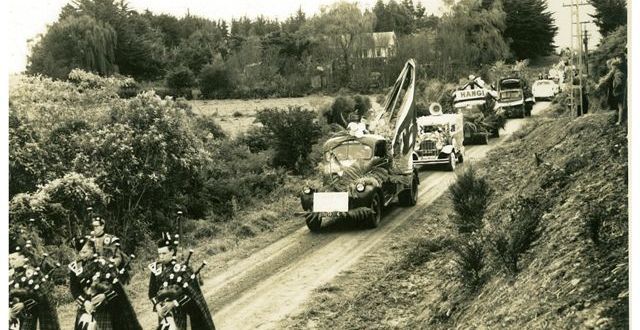
Once the Onetangi Wharf opened in 1924, excursion steamers would bring crowds of
visitors. For the official opening of the wharf, two steamers brought a total of 750
excursioners. Others came to Onetangi by first taking the ferry to the Ostend wharf. It was a
huge event with dancing out the back of the General Store and also at the hall on the corner
of The Strand and Fourth Avenue. When the music stopped at these venues, the pleasureseekers gathered around a bonfire in the middle of the beach and partied on.
Estelle gave birth to her fourth child in this building and, in 1930, just before the birth of
their fifth, they sold the store.
The shop continued as a meeting place and community centre until the late 1950s. During
those nearly three decades, this continued to be the place where people came to pick up
their mail, get their newspaper and, for most of that time, make important phone calls as
the store had one of only 12 party lines in Onetangi. With the arrival of trucks and cars, a
petrol bowser was introduced to fuel them up.
The store was where it would be noticed if a resident looked unwell or hadn’t visited for a
few days, and a neighbour requested to check on them. It was where there would be
someone to listen or help if someone had a problem, crisis or sadness. For some, it was their
only social contact in the day. Of course, it was also the place to purchase all your food
supplies as well as other basic requirements and treats.
Even though the building has now been demolished, there is still a reminder from this
distant past: the concrete wall on the border with The Strand was likely to have been built
some time in the 1930s – probably by Bert – from a uniquely Onetangi mix, and still stands
outside number 115 The Strand.
 Onetangi Community Hall